Physics A Level | Chapter 5: Work, energy and power 5.5 Down, up, down: energy changes
chevron_forward
visibility 323update 4 years agobookmarkshare
When an object falls, it speeds up. Its g.p.e. decreases and its k.e. increases. Energy is being transformed from gravitational potential energy to kinetic energy. Some energy is likely to be lost, usually as heat because of air resistance. However, if no energy is lost in the process, we have:
decrease in g.p.e. = gain in k.e.
We can use this idea to solve a variety of problems, as illustrated by Worked example 4.
WORKED EXAMPLE
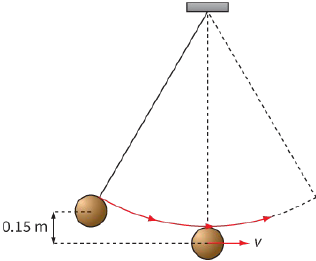
4) A pendulum consists of a brass sphere of mass $5.0 kg$ hanging from a long string (see Figure 5.13).
Figure 5.13: For Worked example 4.
The sphere is pulled to the side so that it is $0.15 m$ above its lowest position. It is then released.
How fast will it be moving when it passes through the lowest point along its path? Step 1: Calculate the loss in g.p.e. as the sphere falls from its highest position:
${E_p} = mgh = 5.0 \times 9.81 \times 0.15 = 7.36J$ Step 2: The gain in the sphere’s k.e. is $7.36 J$. We can use this to calculate the sphere’s speed. First, calculate v2, then v:
$\begin{array}{l}
\frac{1}{2}m{v^2} = 7.36\\
\frac{1}{2} \times 5.0 \times {v^2} = 7.36\\
{v^2} = 2 \times \frac{{7.36}}{{5.0}}\\
{v^2} = 2.944\\
v = \sqrt {2.944} \, \approx \,1.72\,m\,{s^{ - 1}}\, \approx \,1.7\,m\,{s^{ - 1}}
\end{array}$
Note that we would obtain the same result in Worked example 4 no matter what the mass of the sphere. This is because both k.e. and g.p.e. depend on mass m. If we write:
$\begin{array}{l}
change\,in\,g.p.e\, = \,change\,in\,k.e\\
mgh\, = \,\frac{1}{2}m{v^2}
\end{array}$
we can cancel m from both sides. Hence:
$\begin{array}{l}
gh\, = \,\frac{{{v^2}}}{2}\\
{v^2} = 2gh\\
v = \sqrt {2gh}
\end{array}$
The final speed v only depends on g and h. The mass m of the object is irrelevant. This is not surprising; we could use the same equation to calculate the speed of an object falling from height h. An object of small mass gains the same speed as an object of large mass, provided air resistance has no effect.
Questions
11) Re-work Worked example 4 for a brass sphere of mass $10 kg$, and show that you get the same result.
Repeat with any other value of mass.
12) Calculate how much gravitational potential energy is lost by an aircraft of mass $80000 kg$ if it descends from an altitude of $10000 m$ to an altitude of $1000 m$. What happens to this energy if the pilot keeps the aircraft’s speed constant?
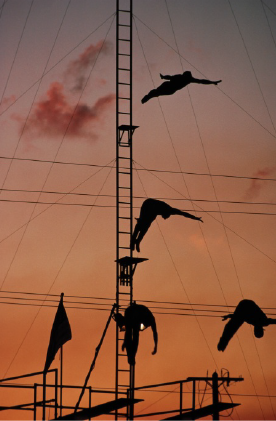
13) A high diver (see Figure 5.14) reaches the highest point in her jump with her centre of gravity $10 m$ above the water.
Figure 5.14: A high dive is an example of converting (transforming) gravitational potential energy to kinetic energy
Assuming that all her gravitational potential energy becomes kinetic energy during the dive, calculate her speed just before she enters the water.